
How to Grow Clematis Montana
Written by Hannah Miller. Reviewed and Fact Checked by Elizabeth Smith. Published to Spring Plants. Updated: 20th February 2023.
Our editors publish helpful guides and insights learnt from years of experience and recent research. They also test, review and suggest plants and products. If you buy something via links, we may earn a commission, but we have a strict editorial process.
I’ve grown clematis montana over trellis and fences on numerous occasions, and despite it being decidious (loses leaves in winter), I’ve found it an excellent choice for masking ugly areas of the garden.
This clematis is fast-growing and in my garden, it produces hundreds of pinkish-white flowers in late spring.
Key points:
- Clematis montana can grow over 10 metres in ideal conditions although I’ve never grown mine more than 6 metres, which is still impressive.
- It’s fast-growing and mine grew over 1 metre each year.
- My clematis montana blooms in May and June.
- The flowers last up to 4 weeks.
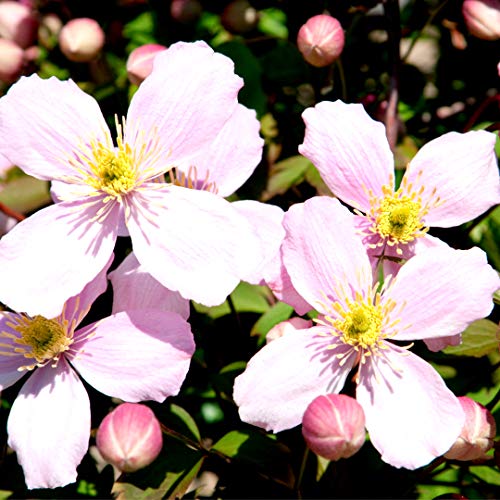
- Four petals surround distinctive yellow anthers.
- This shrub flowers on old wood, so you should only prune to control its shape and size.
- Deciduous – loses its leaves in the autumn and winter.
- I could smell the fragrance in the spring, it’s strong and pleasant.

Size
Height: Up to 12 metres (40′)
Spread: Up to 4 metres (13′)

Type
Deciduous: Dies back after flowering and reappears the following season

Growth
Vigorous – reaches full size in 5-10 years

Difficulty
Easy to grow but can be difficult to control if grown in tight spaces

Native
Asia

Location
Sheltered or exposed. Prefers fertile soil in a spot that’s free-draining. Train up walls, fences, pergolas, garages, sheds and more

Sunlight
Full sun or partial shade

Hardiness
US zone 5-9 and all parts of the UK

Water & Feed
Feed regularly during the flowering season or use slow-release fertiliser and keep the soil moist but not waterlogged

Companions
Clematis montana will smother out most other plants so care should be taken as to where it’s planted although it can be trained. Can be grown up tree trunks

Planting
Plant the crown 5-10cm deep to encourage shoots to grow below ground level. Cap the surface with annuals, bark or pebbles to keep the soil sheltered, cool and moist

Flowering
Blooms for up to 4 weeks in late spring, usually in May and June


Growing Clematis: My Answers to Common Questions
Below I’ll answer questions you may have about this spring climber that I’ve been growing for over 4 years:
How and When are Clematis Plants Sold? When Should They be Planted Out?
Clematis plants can be found in garden centres throughout the year but are best planted out when the soil is neither frozen nor bone dry.
I’ve planted them in my garden in both autumn and spring and they’ve both performed just fine.
I know that clematis in general dislike overly dry soil, so I suggest avoiding planting them in the middle of summer unless you have the time to water them frequently until they are settled
Where is the best location for clematis montana?
All clematis plants prefer moisture-retentive soil that’s never too dry but doesn’t waterlog.
Thus, the best spot is usually where the base of the plant has some protection from the summer sun. In my garden, I’ve achieved this by placing pebbles and rocks around the base, and I’ve seen other gardeners do the same.
I know from first-hand experience that this clematis is the most vigorous climber of the entire species, and it’s smothered a few other plants in my garden.
I suggest you choose your spot carefully; popular locations are:
- At the base of walls.
- Next to pergolas.
- By sturdy fences.
- Next to garages.
- Near a tree so that it can be trained up the trunk.
My clematis montanas are in full or partial sun, and I believe they would struggle if grown in full shade.
How should the site be prepared?
When I planted my clematis montanas, I dug in organic matter to improve the soil and turned it over to improve drainage, and so far, my plants have thrived.
Does clematis montana need lots of water and fertiliser?
While clematis plants should never be grown in waterlogged soil, they do require regular watering during the growing season.
On the few occasions where I have neglected my clematis, it’s responded by growing less vigorously and more wilted, but it’s always perked up quickly after I started watering it again.
I do apply fertiliser to my plants, but only because I’m training them around a large trellis, and I want to cover it as fast as possible.
How tall and wide will clematis montana grow?
Clematis montana has the potential to reach up to 12 metres (40′) and a spread of 4 metres (13′) if grown in ideal conditions and fed frequently, but mine is at 4 metres at the moment and its growth has slowed a little.
This clematis is the most vigorous climber and can outgrow almost any other plant; it will need to be controlled, and I’m currently training mine along a large trellis fixed to a wall.
Clematis montana is not self-clinging; it doesn’t have suckers and will need training or tying in place, meaning it’s not a low-maintenance plant.
How should clematis montana be pruned and deadheaded?
This clematis doesn’t require yearly pruning unless you wish to train it in a particular direction or to keep its growth in check.
Clematis montana flowers on old wood, so it should be pruned immediately after flowering, if at all.
Does this clematis suffer from any pests and diseases?
This plant may suffer from clematis wilt and powdery mildew.
My plants have been problem-free so far, and apart from the training, I would say that growing this climber has been a breeze.
Very few pests are of concern, but aphids may attack new shoots, but again I haven’t had this issue.
When does clematis montana produce flowers and how long do they last?
Clematis montana produces an abundance of flowers in May and June, and in my garden, they last for up to 4 weeks.
Each flower is around 5cm wide and contains four petals around a cluster of anthers.
Can clematis plants be propagated?
This clematis can be propagated by layering – see here for more information.
It can also be propagated by semi-ripe cuttings taken in early summer. This site explains how to propagate by cuttings.
Is clematis toxic or harmful to humans and pets?
Clematis plants are toxic to humans and pets. The leaves are the most toxic part of the plant.
Are clematis plants beneficial to wildlife?
Clematis climbers provide much-needed shelter for butterflies, bees, other insects and birds. In my garden, they have turned a bland and ugly wall into a safe haven for many smaller animals.
Can clematis be grown in pots?
Clematis can be grown in pots and for gardens with a high water table and wet ground conditions, I feel it’s a practical way to grow this plant.
Buy Online:

Growing Clematis: At a Glance
If you’re thinking of growing clematis montana for the first time, here my ten key pointers:
- Grow in full sun or partial shade in moist but not soggy soil.
- Protect the plant’s crown from sunlight and heat by covering it with pebbles, bark, grasses or other plants.
- Feed and water regularly during the growing season.
- Clematis montana is not self-clinging, so it will require training or tying in.
- Expect hundreds of flowers in May and June; based on my experience, these should last up to 4 weeks.
- Blooms only appear on old wood, so if you prune aggressively, it may not flower well the following season but from my past experience, I believe it will recover.
- Pruning is optional but I suggest you do so to keep the plant in check.
- Clematis montana will smother out many other plants, it certainly did in my garden.
- This clematis is deciduous; it will lose its leaves in the autumn.
- Some clematis plants have a distinct vanilla fragrance, and all provide shelter for insects and small birds.
I Recommend This Varieties
Here are 3 clematis montana varieties I recommend:
“Freda” is a less vigorous variety reaching up to 5 metres in height and produces rose-pink flowers on dark green foliage. I feel that this montana is more suited to smaller gardens, climbing up posts and pergolas etc.
“Majorie” is the first-ever double-flowered clematis and boasts soft pink and cream blooms against slightly tinted foliage. Fast-growing and reaching around 7 metres in ideal conditions.
“Grandiflora” is the clematis I’m currently growing and it’s reliable, fast-growing and can reach 10 metres in around 5 years. Pure white flowers come into display slightly later in spring and early summer.
Clematis Companion Plants
Clematis montana is a vigorous climber, and while it may smother out other plants, I’ve found that it can, with care, be paired with:
- Climbing roses.
- Ivy, although care and attention will be required as the ivy may strangle the clematis.
- Wisteria.
- I’ve seen it wrapped around tree trunks (but keep the soil moist).
- Larger or rambling shrubs such as honeysuckle – let the clematis weave over and through the shrubs to add interest.
- Annuals and grasses can be planted at the base of the clematis, where it provides shelter and colour.
Alternatives to Clematis: My Suggestions
There are several alternatives that I have experience growing or have seen thrive in positions that clematis does well in:
The climbing hydrangea is the most obvious alternative and is better suited to more shaded parts of the garden. I’ve seen it cover north-facing walls in gardens and even on houses.
Ivy can cover and mask walls and fences just as well, if not better, than clematis.
Chinese virginia creeper is less vigorous than its well-known relative; the virginia creeper and is more suited to smaller gardens. I’ve seen it grown in sun and partial shade where it produces delightful green leaves with white and pink veins.
The false hydrangea is a vine alternative to the climbing hydrangea and, from what I’ve seen, is less vigorous and easier to control.
Also, consider climbing honeysuckle, which I’ve seen growing over pergolas and arches.
Need to cover vertical space quickly?
Read our guide to the top 10 of the fastest-growing climbing plants.
Daniel’s Pro Tip
Here is a quote from Daniel, our co-founder:
Clematis montana is the fastest growing clematis that I’ve grown sucessfully over walls, pergolas and arches.
I’ve always found the flowers are a delightful welcome sight in spring and unlike many other climbers, the blooms last for up to 4 weeks.
I recommend keeping the root area out of direct sunlight as much as possible by careful location or by growing grasses, plants or even placing rocks and pebbles above the soil.
More Photos


Discover More:
Explore related springtime content from us here at DIY Gardening:
Share This Guide:

Our Expertise: Backed by a Qualified Horticulturist
We follow a detailed, rigorous process to create content that is helpful, factually correct and meets the highest standard of integrity.
Our 5-step process is:
1) We select an author from our pre-approved list.
2) The author creates content based on their knowledge of the subject.
3) We ask a professional with qualifications and experience to fact-check and review the content which we update accordingly, if applicable.
4) The content is checked by the site owners and published.
5) We review the content yearly to ensure it's still correct and relevant.
This guide was reviewed and fact-checked by qualified horticulturist Elizabeth Smith.
Explore: Elizabeth's profile and qualifications.
Meet The Author: Hannah Miller
Hannah is a keen gardener who grows organic fruit and vegetables in her Surrey garden and is moving towards a more sustainable lifestyle.
She is also the proud grower of a dahlia and herb garden.
Hannah worked for the NHS for 12 years but also has a level 3 qualification in horticulture and is currently studying for her level 4.

Explore More of Our Content Below:
The Best Plants for a Low Maintenance Garden
We think these are the best plants for a low-maintenance garden but of course, no plant is 100% maintenance-free. Explore our list today. Start HereGarden Plants For North-Facing Gardens
A shaded north-facing garden doesn’t mean you have to miss out on beautiful plants, explore our guide to plants for shaded gardens. Start Here
Plants for Winter Colour
Say goodbye to dull, grey winters by choosing plants that produce colour all through the cold season. From annuals to perennials we’ve got plants you’ll love. Start Here.

